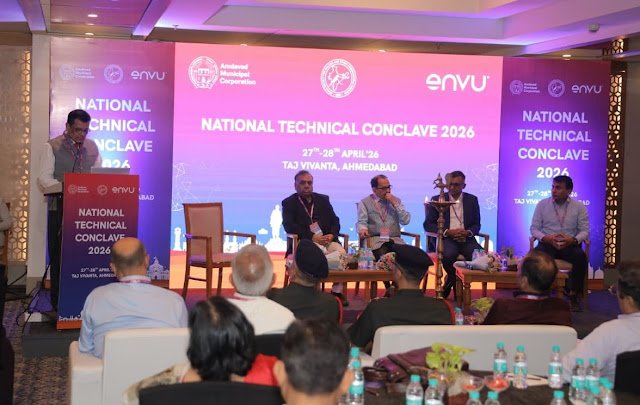

Two-day scientific conclave,
organised by the Indian Society for Malaria and Other Communicable
Diseases (ISMOCD) in collaboration with
Ahmedabad Municipal Corporation (AMC), examines advances in urban pest management and charts a science-led path
forward for India’s cities.
01st May 2026 | Ahmedabad: A national technical conclave on advances in urban pest
management and vector control concluded
in Ahmedabad on 28 April 2026, bringing together senior public health leaders,
government officials, armed forces
medical specialists, and scientific institutions for two days of focused
scientific exchange. The conclave addressed
the growing burden of dengue, malaria, and chikungunya in India’s
rapidly expanding cities, and the need for systematic, evidence-based, integrated strategies to
manage them effectively.
Organised by the Indian
Society for Malaria and Other Communicable Diseases (ISMOCD) in
collaboration with Ahmedabad
Municipal Corporation (AMC) and supported by Envu India, the
conclave drew participants from national
and state public health programmes, the Armed Forces Medical College
(AFMC), Pune, academic institutions, and
international scientific contributors. Sessions covered the epidemiology
of dengue, malaria, and chikungunya in
Ahmedabad’s urban setting; advances in surveillance, including
ovitrap-based monitoring with AI-assisted analysis; the WHO-aligned Integrated Vector Management
framework; the Urban Malaria Scheme and National Urban Health Mission; preparedness for vector-borne disease control
during mass-gathering events; and some innovations in public health insecticides. Envu contributed an international
perspective on integrated urban vector management, drawing on experience from the iDEM (Integrated Dengue
Epidemiology and Management) programme in Malaysia.
Envu India’s support for this
conclave is grounded in a conviction the company holds about the significant
opportunity to advance mosquito control
in Indian cities. Research by the Centre for Science and Environment (CSE),
India, found that the standard
municipal thermal fogging mixture is 95 per cent diesel and 5 per cent
insecticide, with Delhi alone estimated
to consume 4.5 lakh litres of diesel in a single fogging season, comparable to
the daily fuel use of over 2,000 cars.
The WHO’s guidance on Integrated Vector Management recommends going
further: addressing larvae and interrupting
the breeding cycle for sustained, measurable impact, rather than relying on
adult mosquito knockdown alone. Envu
believes Indian cities are ready for that more complete approach, and offers
water-based, WHO Pre-Qualified vector
control formulation combined with safer larvicidal solutions that make it
possible. Envu welcomes engagement from
public health authorities, urban local bodies, and state vector control
programmes on what that transition could
mean in practice for their city or district.
“Vector-borne diseases,
caused by viruses, bacteria, and parasites, account for over 17% of infectious
diseases globally, all transmitted
through vectors. India has made remarkable progress in controlling these diseases.
Malaria deaths have declined from eight
lakh annually at independence to just 83 in 2023. Kala-azar cases dropped from
9,241 in 2014 to 449 in 2024, nearing
elimination, while over 100 districts have eliminated lymphatic filariasis as a
public health problem. Dengue mortality
has also reduced significantly. These achievements reflect India’s sustained
commitment to disease control,”
said Padma Shri Prof. Dr. Aditya Prasad Dash, former Vice Chancellor,
Central University of Tamil Nadu, and
former WHO Adviser.
He added, “India aims to
eliminate malaria, lymphatic filariasis, and kala-azar by 2030. Achieving this,
especially in urban areas, requires
stronger collaboration among scientific institutions, government bodies, and
municipal agencies. Growing partnerships
between academia, industry, and research organisations in innovation,
technology transfer, and policy are key
to this effort. Strengthening such collaborations will be critical for
achieving India’s Sustainable
Development Goals.”
Dr. Bhavin Solanki, Medical
Officer of Health, Ahmedabad Municipal Corporation, said, “Ahmedabad Municipal
Corporation has always believed that public health outcomes improve when
institutions invest in the right science, the
right partnerships, and the right people. Our vector control teams are
trained, equipped, and committed to adopting
approaches that deliver real, measurable results for the communities we
serve. The scientific inputs and global
experience
that Envu brought to this conclave added meaningful depth to the discussions
and helped broaden our perspective on
integrated vector management. Conclaves like this one, which bring together
national scientific expertise,
government experience, and industry knowledge, considerably strengthen that
work. We look forward to continuing to
build on the collaborations that have emerged from this platform.”
M. Arun
Kumar, Managing Director, Envu India, said, “India’s cities are at the centre of the vector-borne
disease risks, and this conclave brought
the right people into this conversation at exactly the right time. As a
company, our commitment goes beyond
supporting events like this. We believe the way mosquito control is practised
in Indian cities today has room to
advance, and Envu is here for the long term, alongside India’s public health
institutions, to help make that
happen.”